Still Something to be Learnt
A fascinating insight into Charles Darwin, man
and scientist, is to be found in an exhibition
dedicated to him at Ruthin Library. Originally
part of the British Library's exhibition in London,
banners and display boards use maps, lists,
illustrations and text to provide
biographical material. AII are colourful,
clearly set out and informative.
Much has been said about Darwin on
television and radio in this, the
bicentenary of his birth, but I found
there were still new fads to be learned
from this exhibition. Scientific events
that led up to his great work ‘On the
Origin of Species by Means of Natural
Selection’ being published in 1859 are
chronicled in detail.
Darwin’s intelligence and curiosity, his
dedication and obsessive search for
knowledge shine through, but glimpses
of his personality and personal life are
included too, and bring the man alive.
For ex- ample, added to the details of
his great journey of 1831-36
circumnavigating the globe on HMS
Beagle, is a list Darwin made of the objections
his father had raised to his taking up the
invitation to be the naturalist on the voyage!
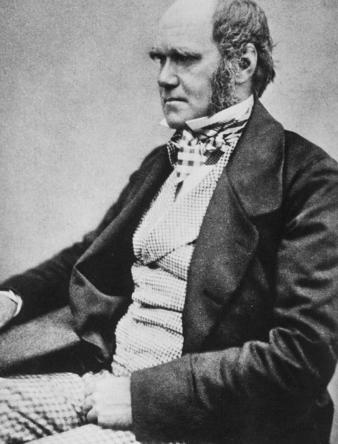
That reminds us that Darwin was not always the
grave elderly, white- bearded scholar frequently
portrayed.
A large chart, designed by Dr Steven Ramm, who
delivered a public lecture to launch the
exhibition, tells of the young Darwin’s visit to
North Wales in 1831, with geologist Adam
Sedgwick in search of old red sandstone (they
didn’t find any—though there is old red
sandstone in Anglesey). They spent the night of
August 6th at the Castle Hotel. Darwin wrote
afterwards that
he had “never
ceased being
thankful for
that short tour
in Wales”.
A collection of
some 20-30
books by or
about Darwin
accompanies
the
display—plenty
of ideas for
follow-up
reading.
Two minor
drawbacks.
Part of the
exhibition is
housed in the meeting room of the Library, to
which access is not always available; it would be
wise to check whether the room is in use before
you leave home. Secondly, to read the banners
one has to stand on the staircase and crane up
at them. Despite these quibbles, the exhibition
is well worth an hour or so of one’s time.
According to one of the banners, Darwin said, of
marriage, “these things are good for one’s
health but terrible loss of time”.
RUTH BACON reviewed the 2009 Darwin exhibition

Town and Around Current Edition
Town and Around Historic Contents
Contact Us
Ruthin Local Historic Society
Copyright © 2018 Ruthin & District Civic Association


