Derwen Through the Ages
In March and June 2018, ISABEL STEWART
explored Derwen and its environs
Derwen is a very small, quiet village some six
miles from Ruthin. It has a mediæval church, an
old lead mine, a quarry, the remains of an Iron
Age Hill Fort, a mediæval well and beneath the
village a lovely U-shaped valley through which
the river Clwyd runs.
Millions of years
ago, when most of
the land was
covered by sea,
the lead mine was
being formed.
Boiling hot water
spouted out of
black smokers on
the ocean floor
containing many
minerals, in this
case mainly lead, which spread over the sea bed
and, over millions & millions of years, the land
rose above the sea and the lead was eventually
discovered and mined.
The U-shape valley was probably created during
the various Ice Ages and I believe a great lake
near Melin y Wig burst through its barrier and
caused a catastrophic flood gouging out the
valley.
The Iron Age hill fort and lead mine are on
private land but I have visited the site and seen
the prehistoric post holes. It must have been a
hard life but worse was to come for later
Derwen residents.
The quarry, Craig Lelo, like the lead mine,
brought in local employment. Limestone had
capped the hill top and was a very good source
of wet stone, the remaining rock being used for
making roads.
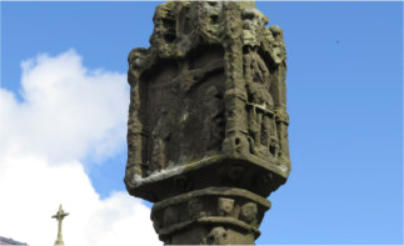
The mediæval church escaped the
reformation and later
Victorianisation and still supports
a rood screen & balcony. An old
carved Celtic preaching cross,
which may pre-date the current
church building, was where
travelling friars gave outside
sermons.
Ffynnon Sara is an ancient well believed to heal
arthritis and cancers. It was probably frequently
visited as it is alongside an ancient pilgrims’
track.
The early 1800s were known as the “time
without summer”. Only now we know that the
cause was when Mount Tambora, a volcano in
Indonesia, erupted and threw masses of gas
and ash up into the stratosphere blocking out
the sunlight. The local residents of Derwen only
knew that the crops failed for three years and
many people died of starvation. One thrifty lady
knitted socks, a common task all the women
did, but she did so from dawn to midnight every
single day. As well as his work, her husband
took over all her usual tasks. These socks were
sold weekly at the Ruthin market and with this
money they were able to pay the exorbitant
prices for the small amount of food available.
Today the village school is now a beautiful
private house, post office, bakers, public house
are all things of the past and the church is now
in the hands of The Friends
of Friendless Churches but
Derwen is still a thriving
friendly village with plenty
of young families.
Ffynnon Sara
Ffynnon Sara is a very old
well situated on the
outskirts above Derwen, on
the minor road from
Claddnewydd leading to
Melin y Wig. It is beside an old Pilgrim Route
which linked St. Winefride’s shrine to St. David’s
and would have been a most welcome site for
the weary traveller.
It was probably once a holy well connected to
the Vale’s mother church eight miles away, at
Llanynys, and from the sixth to the 17th century
was known as Ffynnon Pyllau Perl. (Pearl
Ponds).
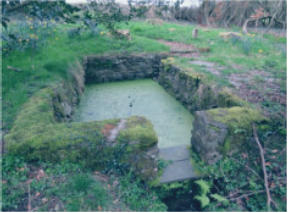
The well is bath shaped, lined with stone, with
three steps leading down into the water, all set
within a pleasant grassy area shaded by trees.
The water bubbles out of the ground into the
well and the overflow joins the Nant Mynian
stream.
A 17th century map indicates a long-vanished
cottage near the well. The well’s name was
changed around this time
and it is said that a lady
living in the cottage was
perhaps the custodian of
the well and maybe it was
named after her. The more
likely explanation is that it
may have been dedicated
to St Saeran of Llanynys.
Ffynnon Sara was believed
to have healing powers, curing cancers, eczema
and rheumatics. Pilgrims left pins behind in the
well as a token of thanks (Google gives an
interesting account of such pins).
In the early 1970s, the rector sensitively
restored the well and landscaped the area. No
mention is made of any pins discovered or any
other artefacts of interest.
For pilgrims, the hedgerows would have been a
great source of delights and relief. Berries and
plants would be picked as they walked along:
blueberries, blackberries & raspberries, St.
John’s Wort flowers containing red hypericum oil
to sooth sores and muscle pains, nettles and
dandelions infused in hot water acting as a
tonic, wild fennel helping digestion, vitamin C
from rose hips and plenty more.

Town and Around Current Edition
Town and Around Historic Contents
Contact Us
Ruthin Local Historic Society
Copyright © 2018 Ruthin & District Civic Association


