Robert Ambrose Jones, literary critic and writer
on politics and religion, died 100 years ago this
year. Better known as Emrys ap Iwan (Emrys
being the Welsh form of Ambrose) he was the
first minister of Tabernacl chapel, Well Street,
where his achievements are now
corfkrnemorated on a new plaque.
Born in 1848 at Abergele, he was the son of a
gardener at Bodelwyddan, who, at the age of 18
decided to become a student at Bala theological
college. Having learnt German and French from
a German neighbour, he called himself a
European, and in 1874 went to teach English at
a private school in Lausanne, Switzerland.
After his return to Wales he was regular writer
for Y Faner (Thomas Gee’s weekly paper,
founded 1859), and was also one of 200
contributors to Y Gwyddoniadu Cymreig (1854-
1879), the 10-volume encyclopædia published
by the Gee Press, Denbigh. He was an important
forerunner of modern Welsh nationalism; he
aimed to inject self-confidence into
the Welsh when imperialism was
rampant and the nation was being
told that its language was useless
and would surely die.
Welsh was not then an official
language, and could not be spoken
in courts of law. Many miscarriages
of justice took place because the
accused had no idea what was going
on. In Ruthin in October 1889, Emrys
accompanied Thomas Davies, a farm
worker, accused of stealing a kiss
from his employer (a woman!).
Emrys ap Iwan insisted that Thomas,
who could not speak English, should
be allowed to give his testimony in
his own language, and that he,
Emrys, should be allowed to defend
him. There was consternation and
Emrys was daubed as an ignorant
peasant by the English
press—although he spoke four
languages, and his English was in
fact superior to that of most of the
jury. This was probably the first-ever Welsh
language protest.
The Calvinistic Methodists had refused to ordain
him in 1881 because of his opposition to the
building of English-language chapels in Welsh-
speaking areas. He was finally ordained in Mold
in l883, and spent the rest of his life as a
minister at the Tabernacl, and Rhydycilgwyn in
Rhewl. Tabernacl was officially opened on
Census Day, 5th April l891, when Emrys was one
of the nine who preached. He has played an
active part in the design of the chapel with its
seats placed in the form of an amphitheatre and
a mosy ub-non-conformist slender tower.
Heavily influenced by the unorthodox French
theologian and mathematician Blaise Pascal
(1623-62), Emrys ap Iwan’s collection of sermons
(”Homiliau”) published in 1906 and 1909 are
considered literary masterpieces. He died of
liver cancer in Rhewl in January 1906, aged 58.
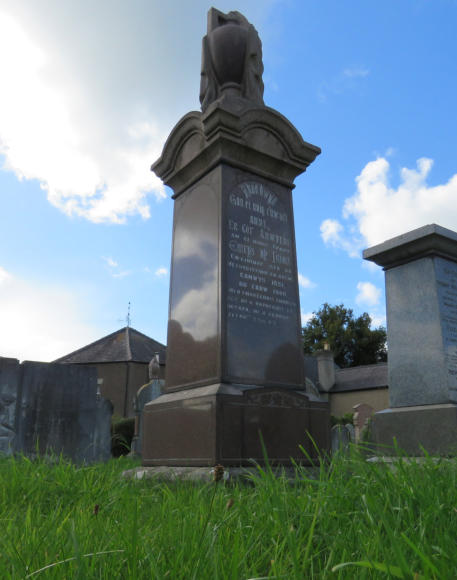
He is buried at the chapel cemetery at Rhewl.
Robert
John
Ambrose
In July 2006,
HAFINA CLWYD
looked at a
distinguished past
citizen of Ruthin

Town and Around Current Edition
Town and Around Historic Contents
Contact Us
Ruthin Local Historic Society
Copyright © 2018 Ruthin & District Civic Association


