A Geological Walk Round Ruthin
In 1831Charles Darwin, an English naturalist,
geologist and author of the book 'On The
Origins Of Species,' had recently passed his BA
exams with honours, and in August that year he
accompanied his geology tutor,
Professor Adam Sedgwick, on a two week field
trip to map the strata of Wales. On the journey
up from Cambridge they stopped off in Ruthin
and reputedly stayed in the Castle Hotel on St.
Peter's Square.
Charles and Adam parted company at Bangor,
leaving Charles free to explore the rocks of
Snowdonia. While in Cwm Idwal he identified
igneous rock and fossil corals. Last year Berwyn
District and Ruthin District Geology Group U3A's
had a field trip to Cwym Idwal guided by Paul
Gannon, mountaineer guide and science
technology journalist following in Charles
Darwin's footsteps. I would like to think that
during Darwin's stay he saw some of the town's
geology in the old building materials and
structures around Ruthin Town. Last year in
October, our U3A Geology Group too geological
walk around Ruthin. We were guided by group
member Brian Hubble who not only gave us a
splendid fact filled tour but also produced a
two-page hand-out. In any town or village, you
can get an idea of the local geology just by
looking at the materials used in the old
buildings as it was so much cheaper to use local
stone.
Our first stop was Bathafarn Chapel which has
300 million years old yellow sandstone around
windows and porch. It may have been quarried
around Ruabon which is known for its Cefn y
Fedw rock. In the walls of the County Hall we
saw belemnites and brachiopods fossils in the
300 million year old carboniferous limestone.
The splendid pillars are of the igneous rock
Larvik. It was probably quarried in the Larvik
mines in Norway. You can see thumbnail size
crystals of feldspar quite easily
The War Memorial which is constructed of three
types of rock. The grey metamorphic Ordovician
slate found in the Ffestiniog and the Dee Valley
region. Permian Triassic sedimentary sandstone
found in Hirwaen and Cheshire and igneous
granite which may have been mined in
Cornwall.
Ruthin or Denbigh quarries could have
supplied the carboniferous limestone
which contains easy to see calcite
tubular corals and circular fossils that
was used to build the Town Hall A great
sight is the kerbstones around St. Peter's
Square which are made of crinoidal
limestone. Crinoids were around in the
Ordovician era about 488 million years
ago. The fossils we see are the broken
stems of the marine animals and look
like miniature polo mints. This limestone
may have been mined around the
Matlock area.
The Old Gaol's carboniferous building blocks
contains brachiopod fossils and the Tom Price
Memorial has a slate plinth probably from a
Berwyn quarry and the main stone is a type of
limestone, a very hard dolomite, which could be
Permian from 200 million years ago.
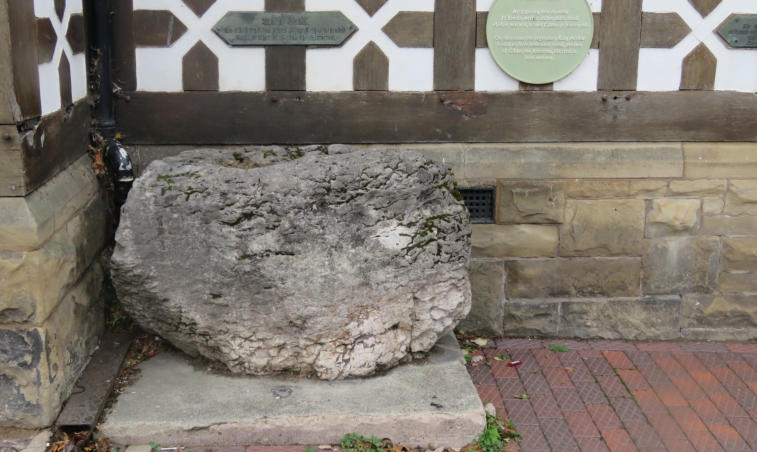
Another very curious and interesting feature is
Maen Huail, the large stone outside the Midland
Bank. It is thought to be an erratic. Erratics are
stones that got wedged under moving ice during
the various ice ages. When the last ice melted
14,000 years ago, stones were left behind on
completely different geological formations.
There is an
enormous erratic Maen Digychwyn in Eryrys
village now used as part of a garden wall and is
well worth viewing.
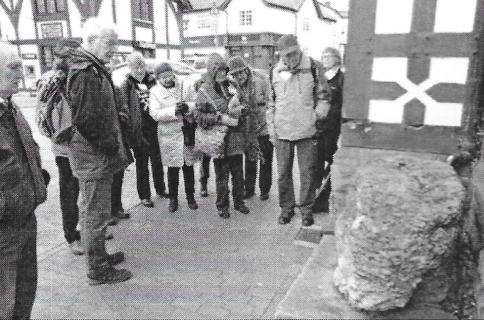
In March 2017, ISABEL
STEWART guided us
through some of the
town’s rocks and fossils

Town and Around Current Edition
Town and Around Historic Contents
Contact Us
Ruthin Local Historic Society
Copyright © 2018 Ruthin & District Civic Association


