Hill Forts
vMoel Fenlli, Moel y Gaer (Llanbedr DC), Moel
Arthur, Penycloddiau, Moel y Gaer (Bodfari) and
Moel Hiraddug could all lay claim to have been
the most important “buildings” in the Vale of
Clwyd. They are certainly the oldest known to
us. They are, of course, the iron age hilltops of
the Clwydian Range, dating from between 800
and 600 BC. Little of them is left—an earthen or
stone rampart here, a hut platform there, and
several ditches. But, according to Ian Brown in
“Discovering a Welsh Landscape: archaeology in
the Vale of Clwyd”, ‘when fully occupied, they
must have been an awesome site and would
have been visible for miles around’.
Our local hilltops form one centerpiece for an
ambitious project to find out more about the
history, prehistory, and ecology of the Vale of
Clwyd, being planned at the moment by a team
which includes Fiona Gale, Denbighshire County
archaeologist, who addressed the AGM of
Ruthin Civic Association, standing in for David
Williams, who was ill, and who, sadly, has
recently died.
The Heather and Hillforts Project (as it is called)
is still in its early stages and covers the
Llantysilio Mountain as well as the
Clwydians—and has yet to obtain major
funding. But its main aims are clear. “We know
far too little about the hillforts”, said Fiona. With
careful planning and expert archaeology we
could find out much more about our
predecessors in the Vale of Clwyd—how they
lived, what kind of buildings they lived in, how
they protected them, what they ate, what gods
they worshipped. They need conservation just
like more modern buildings in towns and
villages. But the project would be about Heather
as much as hilltops; in other words, it would
explore all current ecological challenges to the
Clwydians and Llantysilio, from bikers, walkers,
and even farmers—working out how to
conserve our landscape for future
generations—but without being obscurantist or
anti-everything modern.
The project planners are keen to involve all of us
descendants of the Iron Age peoples, and,
during October, they also sought the opinions of
expert visitors from South Wales, Scotland,
Holland, Slovakia and the United States, who sat
in on public meetings as well as walking the hills
and making their own assessments. Their report
will be published shortly, and used to help put
together the application for major funding.
Ruthin and District Civic Association hopes to
play its part—in the first place, by organizing
conducted tours of the hilltops next May. Bobby
Feeley, newly-elected to the committee, will take
the lead. Meanwhile, we are adding hilltops to
our existing tally of buildings in Ruthin and
district, which need conservation, careful
watching and public education.
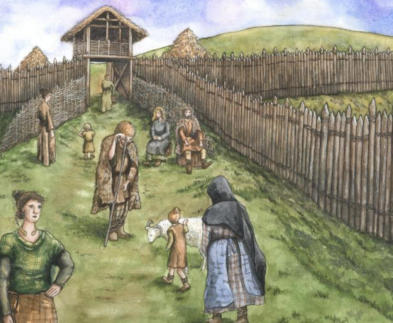
Long before Ruthin was thought of, hillforts provided shelter and
Protection... the built environment of the iron age needs conservation, too,
wrote DEREK JONES, in December 2012

Town and Around Current Edition
Town and Around Historic Contents
Contact Us
Ruthin Local Historic Society
Copyright © 2018 Ruthin & District Civic Association


