Llanbedr Dyffryn Clwyd
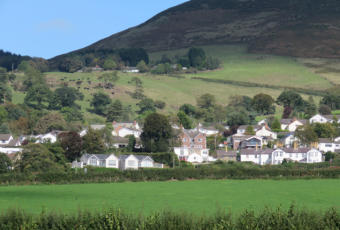
This delightful village lies two mites out of
Ruthin towards Mold. It is generally known as
Llanbedr DC, and, as the name implies, the
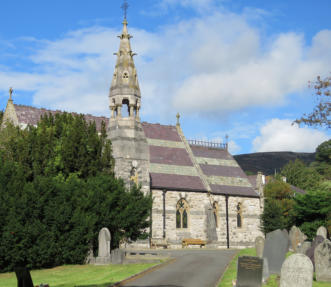
church is dedicated to St Peter. This very
imposing church can be seen at the foot of the
hill known as Bwlch Pen Barras, opposite the
Griffin. It was dedicated in 1863, after the
original mediæval building, which was
mentioned in the Norwich Taxations of 1254,
was abandoned in 1863. The ruins of the old
church can be seen in a field near Llanbedr Hall.
The new church has been caIIed “a Victorian
exuberance”. It has a spiky spire. A 14th century
gravestone in the porch
(similar to one found at Valle Crucis near
Llangollen), an attractive stained glass window
in memory of Mary Eliza Lloyd of Berth, and a
stone reredos behind the altar depicting The
Last Supper all feature.
Isaac Foulkes, known as ‘Llyfrbryf’ (Bookworm) is
buried in the churchyard, as are Violet Jones, the
‘Nightingale of Nantclwyd’ and her husband
Towyn Roberts, who founded a scholarship in
her memory, awarded at the National
Eisteddfod every year for the purpose of helping
promising young singers.
Llanbedr village is largely anglicised and l am
told that very few of the original families still live
there. Living at Berth in 1881 was a wealthy
young man of 23, Edward Owen Vaughan Lloyd;
he had a housekeeper, a
butler, a cook and two
housemaids. The family
had been in Berth for
generations and were
related to the Lloyds of
Rhagat near Corwen.
Edward became a JP and
High Sheriff of
Merioneth. Edward could
trace his family tree back
to Gruffydd ab Adda ap
Hywel ap Ieuaf ap Adda of Llys Trevor and his
wife Angharad, daughter of Owain ap Gruffydd
Lord of Dinmael in the early 14 century.
Here in Berth in 1862 was born John Puleston
Jones, always known as the blind preacher, after
suffering an accident when he was a toddler. He
went to Glasgow University and won a
scholarship to Balliol College Oxford, where he
won a First Class Honours degree in History. The
Pulestons trace their family back to Hamo de
Pyvelsdon in 1150, a family which came from
Normandy in 1087.
Llwynedd Chapel used to stand on the sharp
bend as you travel towards Mold. On Rhiwsig
Farm nearby lived Hugh Hughes, and his large
family, which had Quaker connections. Hugh
was the great grandson of Richard and
Catherine Tudor Hughes of Sarphle, Llanarmon
DC, pioneers in the nonconformist movement,
and often in trouble for allowing meetings in
their garden—under a sycamore tree which is
still there.
Richard and Catherine had 10 children, each of
whom had an average of 12 children! On
Richard and Catherine’s gravestone it was noted
that they left 168 living descendants. AlI their
children lived until their 90s. Among
their descendants were the poet, Ceirog;
Hughes and Son, the Wrexham publishers; Sir J
Herbert Lewis and J. Herbert Roberts later
known as Lord Clwyd.
Hugh Hughes of Rhiwsig and two sons
emigrated to the United States in 1891, because
of the Tithe Wars. His wife Mary was expecting
her eleventh child at the time, and soon after
Jane Grace was born, she and nine other
children sailed to join the father in Oneida
County, New York State. What a gutsy lady!
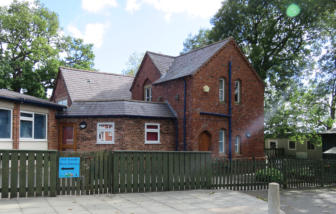
People often ask why Llanbedr School is so far
out of she village. At one time, it was situated on
the corner opposite the church on the road to
Llangynhafal. But the innkeeper at the Griffin
was tired of all the noise which emanated from
there and offered a piece of land to the church
authorities, so that they could build a new
school—and leave him in peace!
We hear a lot these days about ‘missing
persons’. Mr Grfffiths of Wern Farm went
missing in 1886. He took five cows to the market
in Denbigh, and sold three of them. His wife
went home on the train, while he walked the
remaining two cows—but he vanished and was
never seen again! The cows turned up,
though—they were found
wandering in Llandyrnog!
There was a bit of a to-do in
the church in 1891. John
Jones, the rector, had been ill
for a few weeks. His place
was taken by the Revd J.
Gallagher of Clwyd HaIl, late
of St
Cuthbert’s Liverpool, who had
married the owner of the
Hall. Gallagher took ‘Welsh Workmen’ as his
subject for one of his sermons (I don't think they
are mentioned in the Bible); but he called them
‘jerry workers’, suggesting they were lazy, full of
deceit, thinking only of their wages. The choir
and the congregation stood up and walked out!
There is a lot more to say, but the editor is
looking daggers!
Then Editor Derek Jones Replied…
Hafina, wouldn’t dare! And, as a matter of fact I
myself have something to add from one of the
articles l wrote for Censorship—a World
Encyclopedia, published 2001. It was 1960, the
year Penguin Books published unexpurgated
Lady Chatterly’s Lover. Following that,
Denbighshire County Council removed 300
books from its shelves, and the outraged chief
librarian, Eric Luke, encouraged his wife, who
was a member of Llanbedr Women’s Institute, to
campaign against ‘pornographic’ books. She
said, “There are people who would condemn us
for trying to set ourselves up as judges, but the
public libraries are maintained through the rates
and taxes we all pay, and the books they contain
should appeal to the majority and not to the
sadistically-minded minority. DJ .
An April 2009 profile by HAFINA CLWYD

Town and Around Current Edition
Town and Around Historic Contents
Contact Us
Ruthin Local Historic Society
Copyright © 2018 Ruthin & District Civic Association