The rise of non-conformism in Ruthin and
Wales, more generally in the early nineteenth
century, led to pressure for non-Anglican
primary schools, known as 'British' schools, to
provide non-denominational education. Rhos
Street School was such a school.
Founded in 1840, it initially used the Anglican
Chapel of Ease in Rhos Street before acquiring
its own building nearby, five years later,
described as ‘an iron building of neat
appearance’. Ironically, this was funded
principally by an Anglican, George Johnson of
Llanrhudd Hall.
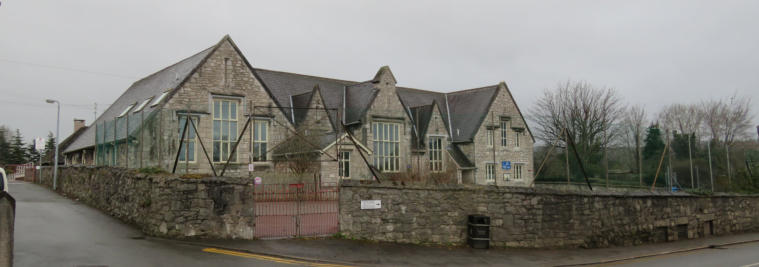
The present stone building, designed by Richard
Cash (as was the similar but rival Borthyn
'National' Anglican primary school), was erected
in the fashionable Elizabethan revival style in
1848. Restricted to boys initially, girls were
admitted in 1847, and children from the nearby
Ruthin Workhouse two years later. From an
initial intake of 193, pupil numbers it swelled to
289 by 1895, an unusually large number given
the population of Ruthin at that time. Again, for
its time, the school had a very wide curriculum.
In the 1930s the school became a local authority
Mixed Council School, with 132 pupils. Numbers
had increased to 169 by 2013, by which time it
had been re-designated a County Primary
School.
In 1984, popular demand for a separate Welsh
language primary school, led to the creation of
Ysgol Pen Barras, sharing the same site. lts
initial intake of 58 pupils had risen to 248 by
2011, putting enormous pressure on space and
resources and growing demand for new
premises for both schools. They leave for their
new location with well established reputations.
Rhos Street School—a brief history
by Arnold Hughes (March 2017)

Town and Around Current Edition
Town and Around Historic Contents
Contact Us
Ruthin Local Historic Society
Copyright © 2018 Ruthin & District Civic Association


