St Peter’s Church celebrates its 700th
anniversary this year. In 1310 John de Grey, 2nd
Baron Grey de Wilton, was granted permission
to found a collegiate church for the growing
community around Ruthin Castle, which had
been built by his father, Reginald de Grey, the
first baron, in 1282. The church building, which
was approved by Anian, Bishop of Bangor, was
to be served by seven priests, known as canons
who would live in a self- governing community
under the presidency of a provost, rector or
warden. To this day, the vicar of St Peter’s is
known as Warden, a title peculiar to Ruthin;
today’s warden, on the other hand, is on his
own, looking after congregations in Ruthin itself,
at St Meugan’s and, now, St Mwrog’s as well.
Also in 1310, Chirk Castle and Denbigh Castle
were completed; Bala was founded; Duccio
painted the Raising of Lazarus (still in Siena
Cathedral, ltaly) and Christ and the Samaritan
Woman (now in the Kimbell
Gallery, Fort Worth, Texas,
USA); ’Ala-ud-din, sultan of
Delhi invaded Malabar in
South India; the Arabs and
Mongols invaded Arbela, Syria
and sold their surviving
inhabitants into slavery;
famine swept through
Timbuktu, Mali, West Africa;
and Goronwy Gyriog, the
Anglesey poet was born.
As is well known locally, St Peter’s was not the
first Christian building in the area. That honour
belongs to St Meugan’s Church, Llanrhydd,
although no trace of the early St Meugan’s
remains. The collegiate church in Ruthin took
over as the most prominent church in the area.
Other collegiate churches included Westminster
Abbey, St Giles Cathedral Edinburgh, what is
now Manchester Cathedral, St Endellion,
Cornwall, and, nearer home, the church of St
Mary Magdalene, Bridgnorth, Shropshire. We
don’t know how much the Ruthin Collegiate
Church was involved with Ruthin School,
founded around the same time, but it seems
likely that they had a major part to play. The
members of the Ruthin college were originally
secular priests rather than monks or friars, but
they may, at some stage, have linked
themselves to the Augustinian Order of Friars,
which was devoted to study and community.
That would explain why the Ruthin college,
along with other minor religious houses, was
closed down in 1536 after Henry VlII’s
dissolution of the monasteries. The church’s
status and influence in the community now fell,
but was restored in 1574, when Ruthin-born
Gabriel Goodman, Dean of Westminster for 40
years, returned to his birthplace, restored the
educational work of St Peter’s by re-founding
Ruthin School, and in 1590, the social care by
establishing Christ’s Hospital, which provided
homes for 12 poor people. He re-introduced the
office of Warden.
The Revd Stuart Evans, appointed Warden in
May this year, is thus the latest in a long line.
Born in Denbigh, he grew up in Bodfari and is a
fluent Welsh speaker. He was educated at Ysgol
Maes Garmon and Abelystwyth University,
where he studied English and drama. He spent
two years as a VSO worker in Egypt before
returning to the UK in 1980 to train as a teacher.
After teaching in secondary schools in Wigan, he
moved to Singapore to work at the United World
College of South East Asia, where, for six years,
he taught drama to students from some 80
different nationalities. His experience there
convinced him to fulfil a long-held personal
belief that he was called to the Anglican
ministry. Following training at Trinity College,
Bristol, he was appointed assistant curate at
Connah’s Quay then, in 2002, as vicar of
Rhosllannerclun|gog, Wrexham.
Stuart Evans hopes that all the people of Ruthin
can regard St Peter’s as their church, regardless
of their beliefs. He is keen to promote a feeling
of croeso, hospitality. The church building is
open for much of the day so that Ruthin
residents can enjoy its peace and tranquillity. A
friendly, sympathetic person, Mr Evans told
Town and Around that he is eager to listen to
what the people of Ruthin want from their
church community. He wants St Peter’s long
tradition of educational and social care to
continue. Indeed, he would like them to grow
during his ministry in the town.
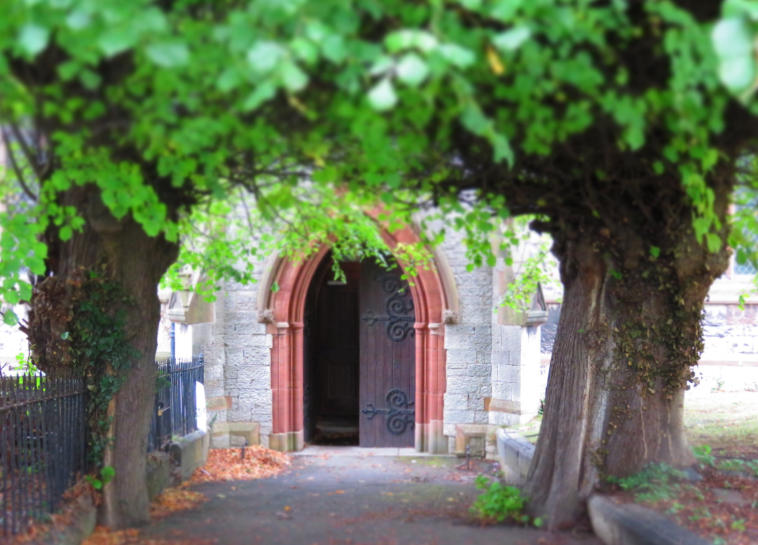
Many people will want to take a
closer look at St Peter’s for its
birthday perhaps during the
forthcoming Heritage 700
Weekend. ln1310, the building
would have been different in
appearance to the church we know
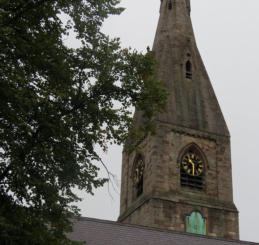
today. Over the centuries additions
and improvements were made,
perhaps the most striking being
the erection, in 1859, of the spire,
designed by the Wrexham-based
architect Richard Kyrke Penson (his family firm
also built the Butchers’ Market in Wrexham, a
very different kind of building). Visible for miles
around it has become a familiar, even iconic,
part of the Ruthin’s skyline.
Inside, Town and Around offers the following
suggestions for those who wish to explore St
Peter’s in close- up:
The double nave. This feature is peculiar to this
part of the world. Was it built due to pressure
on space or did one local church set the ball
rolling with others following, to keep up
appearances? Which came first, the north por
south nave?
The wonderful carved roof. The beams are
especially interesting illustrating coats of arms,
badges and inscriptions. Among the families
represented are the Stanleys.
Extensive references to the Goodman family,
including Gabriel’s bust in the chancel, and no
less than two brasses, (1560 and 1583) devoted
to his father Edward Goodman, one shared with
his wife Ciselye.
The Wadsworth-Willis Pipe Organ, a relative
newcomer, installed in 2003. St Peter’s
reputation for its music, especially its choral
work, is growing and the new director of music,
Peter Litman, wants to expand it further.
The Old Cloisters. They were much latered
during the 19th century but the splendid 14th
century undercroft, built at the same time as the
church itself, is still intact, and can be seen
during the Open Doors Weekend.
The ornamental gates to the churchyard, made
by Robert Davies of Bersham in 1727. They are
closed most of the time. The new Warden,
Stuart Evans, is pondering how to show off their
magnificence as well as encouraging people
through them. He would be pleased to hear any
ideas on how this can be achieved.
In Ausgust 2010, RUTH BACON and DEREK JONES joined the celebrations for one
of Ruthin’s most important and prominent buildings
St Peter’s is 700 Years Old

Town and Around Current Edition
Town and Around Historic Contents
Contact Us
Ruthin Local Historic Society
Copyright © 2018 Ruthin & District Civic Association


