The Thelwalls of Plas y Ward and
Catrin of Berain
In the Tudor period, a significant
number of the inhabitants of Denbigh
and outfit contributed to the life and
work of the monarchs Henry VIII and
Elizabeth I. They also were part of the
abort and progress of the City of
London and of the University of
Oxford.
One of the earliest was Sir John
Salisbury (1506-1578) who has
knighted by Henry VIII, He was a
member of the first Parliament,
Receiver of North WaIes, ChancelIor
and chamberlain of Denbighshire. He
was a very rich man; he built a
mansion on the fertile and to the east
of Denbigh: Lleweni.
His assets there were admired my the
well-born daughter of the farm Berain,
on the shoulder of the Vale of Clwyd,
between LIansannan and Llannefydd.
In the early 1560s, Catrin of Berain was
married to John Salusbury, son of Sir
John. She was a daughter of Sir Roland
Velville of Beaumaris, who was an
illegitimate son of Henry Tudor, King
Henry VII. So, Catrin was a cousin of
Queen EIizabeth. Catrin’s second son John spent
most of his time from 1594 to 1601 in London,
as a trainee lawyer at the Middle Temple and
part of :he Court entourage (”squire of the
body”) of Elizabeth. He came out against the
Essex Rebellion and was knighted in June 1601
by Elizabeth. In that year he pubIished a book
“Love’s Martyr” which contains contributions
from four prominent theatre-writers on the
theme of “the Phoenix and the Turtle”. One of
these was William Shakespeare, which has given
rise to the proposal that there was a friendship
between the two men.
Catrin’s first husband died. She then married
Richard Clough of Denbigh, one of the richest
men in Britain. He was a partner to Sir Thomas
Gresham, founder of The Royal Exchange (Stock
Market). Richard was a merchant, based in
Antwerp, and a financier. The Queen gave Catrin
two wedding presents, a fine embroidered
stomacher and a pair of satin slippers. Back in
Denbigh, Richard built two fine houses, Plas
Clough, Denbigh, and Bachegraig, between
Denbigh and Tremeirchion. However, Richard
died in Hamburg, some three years after his
marriage. Catrin returned, carrying her late
husband’s heart and right hand in a silver
casket, to be buried in Denbigh.
Catrin then married, for the third time, Maurice
Wynn of Gwydir, Llanrwst. A few years later,
after she was widowed for the third time, she
accepted a proposal of marriage from a much
younger man, Edward TheIwalI of PIas y Ward,
Ruthin. Here she died. She was buried at
Llannefydd Church on September 1st, 1591,
alongside her first husband. The name of the
house derives from the family of Walter Ward
who Iived there in the mid-fourteenth century.
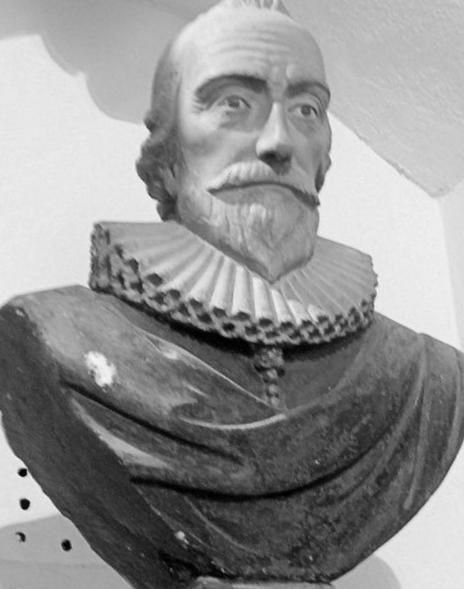
Edward Thelwall (d. 1610) was the eIdest son of
the distinguished Simon Thelwall (1526-1586)
who represented Denbighshire in a number of
Parliaments. He was high sheriff of the county in
1572 and judge at the Court of the Marches in
1582. He wrote lengthily on the law and was one
of the barons and justices of the seven shires
(Chester and the six shires of Gwynedd),
appointed by Queen Elizabeth. He died in 1586
and is buried in Ruthin.
From the same family comes EubuIe Thelwall
(1562-1630) who became principal of Jesus
College, Oxford, and is buried in the college
chapel. This is part of this college’s long
association with Wales.
Edward Lord Herbert stayed in Plas y Ward. He
writes, “After l had attained the age of nine…
parents thought fit to send me some place
where l might learn the Welsh tongue, as
believing it necessary to enable me to treat with
those of my friends and tenants who
understood no other language, whereupon I
was recommended to Mr Edward Thellwall, of
Place y Ward in Denbyshire: this gentleman I
must remember with honour, as having himself
acquired the exact knowledge of Greek, Latin,
French, ItaIian and Spanish, and all other
learning, having for that purpose neither gone
beyond seas, nor so much as had the benefit of
any universities... I did as little profit in learning
the Welsh, or any other of those languages that
worthy gentleman understood, as having a
tertian ague for the most part of nine months,
which was all the time I staid in his house”.
The family of Thelwalls is perhaps the oldest in
North Wales of EngIish extraction connected
with the parishes of Ruthin and LIanrhydd, and
with the Goodmans.
Lord Herbert of Cherbury (1583-1648) was a
widely- published scholar and author in the
fields of theology and philosophy. He was
brother to George Herbert, the poet. His contact
with the Vale of Clwyd and Edward Thelwell may
well have contributed to the quality of his
writings.
JOHN IDRIS JONES explores the Tudor connections of one of Ruthin’s early homes

Town and Around Current Edition
Town and Around Historic Contents
Contact Us
Ruthin Local Historic Society
Copyright © 2018 Ruthin & District Civic Association


