1

Town & Around
O Gwmpas y Dre
Spring 2026
News, Comment & Features from the Ruthin & District Civic Association since 2003




1
It’s hardly a surprise that the
announcement of the long-awaited town
centre public realm ‘levelling up’ work
now starting has been met with a wave
of cynicism and gloom. Undoubtedly, this
will have a short-term impact on trade in
the town. However, several
misconceptions need addressing.
By the time you read this, we expect
the diggers to be out. A new era is on the
cusp of unfolding. Works are due to
carry on until November 2026, but we
anticipate this may well extend into the
new year. Should this happen, there will
be a break in December for Christmas.
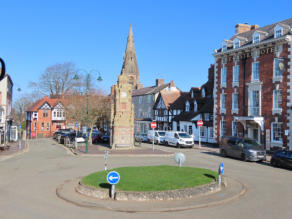
The roundabout has emerged as a
focal point of contention, even among
non-drivers. One particularly peculiar
remark came from an individual who
condemned the entire plan as not
pedestrian-friendly enough, all while
bemoaning the removal of the very
roundabout!
The roundabout is, without
doubt, the most pedestrian-
unfriendly feature in the town
centre. That vast expanse of
grey creates a formidable barrier
for those on foot, obstructing
their natural desire lines. Drivers
approaching the roundabout
typically only glance right,
neglecting to look left, which
endangers pedestrians
attempting to cross or already
doing so.
On the streets (rather than on
Facebook) other comments have
surfaced, such as ‘They’re taking
away parking spaces’. That’s not
true. The number of parking spots on
and around The Square will remain
unchanged. Additionally, blue badge
holder parking will now be available,
which is currently absent.
Importantly, the Town Council is
subsidising 30 minutes of free parking in
the Square car park for five years and
this will approximately double the
number of free 30-minute spaces in that
vicinity.
But allied to this is at least an attempt
to prevent vehicles obscuring the east
side of the Square and to have footways
that can see hospitality trade spill out
continental-style.
Another concern voiced is that ‘The
one-way scheme won’t work’. Mixed
reviews, here. While it regrettably will
lead to increased traffic speeds along
Well Street and upper Market Street, one
benefit is the provision of more on-street
short-stay parking spaces. This should
help traders on Well Street and The
Square.
Pedestrians spend money in town.
Drivers rat-running through do not.
Roads that are easier to cross must be
welcomed. As is the space that will make
the Festival and Christmas market
better. And, who knows, we may yet see
more events on the Square as a result.
Squaring the Circle
by Gavin Harris
Ruthin Future, also known as Dyfodol
Rhuthun, is a sustained place-making
and community planning initiative led by
Ruthin Town Council, shaping
conversations around the town's
development for over a decade. This
evolving plan is deeply rooted in
community engagement, cultural identity,
heritage preservation, and the
incremental transformation of the historic
market town.
Launched in 2011 in response to local
aspirations, Ruthin Future serves as a
strategic approach to envisioning
economic vitality, public spaces, culture,
and community life. Its tagline ’Small
Change—Big Difference’ embodies the
belief that accumulative smaller
improvements can lead to meaningful,
sustainable change. Unlike traditional
masterplans that outline fixed
recommendations, Ruthin Future’s
Ruthin Future: a Long-term
Place-making Initiative
Continued on p 8
................................................................………………………………….
Will the work will kill
the town?
‘The work will kill the town’ is another
oft heard comment. The public realm
work has the propensity to rejuvenate
the town. There will be some short-
term pain but the state of Ruthin at
present is already not great. Can it get
worse? 2025 was fair in terms of
seasonal visitors but it’s we residents
who need to support local businesses
all year round. The fact is that we do
not.
Pre-covid figures released by the
County Council in 2019 when the town
was fuller and healthier suggested that
only four per cent of Ruthin’s residents
were shopping for comparison goods
in town. Seven times that number were
shopping in Chester and its retail
parks. More than twice that number
shopped in Mold. The same number of
Ruthin residents shopped for
comparison goods in Liverpool as in
Ruthin. On the other hand,
convenience shopping (e.g. grocery)
saw 40 per cent of residents shopping
in town and its immediate environs.
This was before Aldi.
2
2
I know what you’re thinking: here we go
again. And yes, I must apologise for the
repetition, but it’s really more about
sheer frustration than anything else.
Let’s face it: trying to find out when
the Cunning Green will reopen is like
trying to get an actual answer from a
politician (and I am one of those, too!).
I’ve pestered the relevant parties
multiple times, but the updates are
about as elusive as a decent cup of
coffee in a certain national chain locally.
According to the County Council, the
responsibility for the delay behind this
debacle lies with the owners of Ruthin
Castle. Apparently, their work isn’t up to
snuff yet. But why on earth can’t we
impose some actual enforcement to sort
this out? The path has been closed for
what feels like an eternity and it’s
getting old.
So, here’s my battle cry: I urge
readers to make representations to the
County Council with your concerns
about this issue and call for action to
be prioritised. We can't simply sit back
and play the blame game any longer.
The Cunning Green is vital for our
community. It’s one of those paths that
townsfolk and visitors alike depend on.
Ruthin deserves the same care and
attention as every other town in the
county.
■ When
eventually
opened, no one
can guarantee it
will stay that way.
We can
anticipate further
closures as and
when other parts
of the wall
become weak or
even collapse,
perhaps during
some future
storms.
We now need
a town-wide
project in order
to safeguard the
entire length.
From the Chair

The Wimds of Change
Or no change at all.
Peter Daniels digs deep
and celebrates Ruthin
If, like me, you share a love of
statistical analysis and spreadsheets,
then the perusal of the November 2025
Wales Index of Multiple Deprivation is
an absolute must. WIMD is a Welsh
government tool designed to measure
and understand levels of deprivation
across various communities in Wales. It
offers a comprehensive analysis of the
socio-economic challenges faced by
different areas. Its primary purpose,
therefore, is in identifying, informing and
the monitoring of deprivation and, by
extension, informing policy decisions.
But the analysis can equally be
turned on its head, to look at the least
deprived, as well.
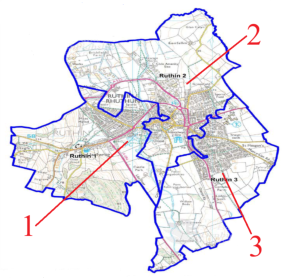
Ruthin is divided into three ‘lower
super output areas’ of similar population
sizes. In the 2025 analysis, Ruthin 3
was the least deprived area in all of
Denbighshire (read as wealthiest).
Ruthin 2 came out 12th of the 58
Denbighshire LSOAs. Ruthin 1 was
36th. Ruthin 1 more or less could be
considered nearer the average in Wales.
It was actually positioned in the top 40
per cent in Wales. Ruthin 3 is actually
36th out of 1917 LSOAs in the whole of
Wales.
On the other hand, Rhyl
contained some of Wales’
most deprived areas. The
2025 Wales index of pointed to
nine of Rhyl’s 16 LSOAs in the
bottom quartile.
Six were in the bottom 10
in Wales. Rhyl West no. 2 was
the most deprived in all of
Wales. In response, a
Denbighshire spokesman said
that although some
neighbourhoods in Rhyl were
very deprived, they ‘do not
represent Rhyl as a whole’,
adding that ‘Rhyl’s
regeneration is under way but
this long-term vision takes
time’. However, figures from the 2008
index of multiple deprivation also put six
of Rhyl’s LSOAs in the bottom 10 per
cent. Within that bottom 10 per cent in
2008, Rhyl’s LSOAs were ranked at
positions 1, 4, 5, 67, 87 and 152.
Ruthin has also been consistent.
Denbighshire is a somewhat artificial
construct and it may be better to
consider Ruthin (and Rhyl) alongside
others in the north east of Wales. In
lumping Denbighshire with Flintshire
and Wrexham, Ruthin 3 emerges as 7th
out of 234 LSOAs. Above it, no one can
touch Marford and Hoseley. Then
there’s Borras Park 1, Mold South 2,
Argoed 1, Garden Village, and
Rhosnesni 2. Ruthin 2 is at 82. Ruthin 1
weighs is at 116th out of 234, is within
the third quartile and again might be
considered average for the region.
Rhyl, on the other hand, has 10 of its
16 LSOAs in the bottom quartile. Only
one reached the top quartile, just
squeezing in.
Meanwhile, of the villages around
Ruthin also score well. Llanbedr DC with
Llangynhafal scores 38th; Llanarmon
with Llandegla 94th; Llandyrnog 102nd;
Llanfair DC with Gwyddelwern 114th;
and Efenchchtyd (including
Clawddnewydd and Cyffylliog) 131st.
An Apology
Please accept the Civic
Association’s apologies that this
edition doesn’t fill the usual 12
pages.
The publication is dependent
upon the number of articles and
suggestions we receive. On this
occasion, we simply do not have
enough content to fill all 12 pages.
Please consider penning
something for us. Contact details
on the rear.

................................................................……………………………………….……………………..............
It surely cannot be long till the
path opens: the Castle Hotel
has made good the collapse,
even if it hasn’t rebuilt the wall.
It requires fencing off
Ruthin Lower super output areas
3
3

News of a forthcoming
celebratory (or
commiserative?) book
Many happy returns to Denbighshire
County Council as it approaches its 30th
anniversary on April 1st, 2026.
In celebration, Peter Daniels brings out
his fourth book, the proceeds of which
when sold during his mayoral year go
towards the mayoral charities 2025/26.
Titled ‘Long Shadow’, Peter examines
the predecessors, the road to
reorganisation, Denbighshire’s troubled
early history, the stable middle years, and
the latter day problems. It looks at
successes and the failures. Expect to see
sections on the Rhuddlan debt, the volte
face of the early 21st century school
closures, Clwyd Leisure and, later, the new
waste model. Local topics include the Craft
Centre, new schools, levelling up, and
County Hall.
This is not an exposé. But
Denbighshire certainly has had
something of a chequered history.
Amazingly, in spite of threats by the
Welsh Government to redraw the
boundary maps, Denbighshire has
existed eight years longer than its
immediate predecessor, Clwyd.
As a conclusion, there is a brief
analysis of the authority and its strengths
and weaknesses.
Due for publication in April 2026, this
may only be available as an ebook. If so,
it can be ordered on Kindle and read on
free Kindle reader apps for iPhones,
iPads,and Android phones and tablets,
and even for Windows PCs.
The publisher Hiraethog Books has
to date not made a decision about hard
copies.
■ Meanwhile, the author’s ‘21st Century
Ruthin’ remains available from Nest,
Clwyd Street, or through enquiry via the
publisher’s webite at:
hwww.hiraethog.co.uk
Happy 30th Birthday
Levelling Update
As we write this, Well Street, the
rear of The Old Courthouse and
Market Street are about to be
‘levelled up’.
By the time this is published, we
expect the roundabout to have
gone. It won’t be missed by us.
The works on Well Street and
Market Street will eventually see
both as one-way. This will provide
additional on-street parking places.
Market Street can expect a much
more compact ‘feel’ to it that will
benefit pedestrians.
Meanwhile, works within the
front building of the Old Gaol (no.
46 Clwyd Street) is almost
concluded. Construction is complete and
it is currently being fitted out. We can
expect exhibition and interpretation
spaces and a café.
Cae Ddôl Park
Work at Cae Ddôl Park is due to
commence this spring. Although some of
this will necessarily need to take place
during the summer, when residents and
visitors will be more active, the ground
conditions will be that much better,
reducing collateral damage to in the
vicinity of the works. Some of the work
has to await the conclusion of the rugby
season.
The work incudes a new active travel
route. It was once angular in nature but
has been ‘softened’. The facility is being
re-routed to avoid the former oak area
and will now run near the lake. Where
appropriate, this will be on a boardwalk.
Also in Cae Ddôl will be a canopy
and an nearby events area. The prospect
of a much-supported bicycle pump track
remains rosy, adjacent to the current
skatepark. This will have modular
concrete elements and more traditional
blacktop elements.
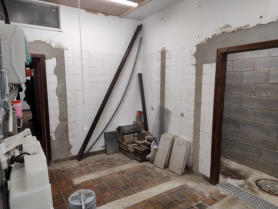
The scheme at Cae Ddôl envisages
improvements to the 40-year-old
lavatories at Crispin Yard, to include a
fully-accessible 24-hour facility to be
opened by credit or debit card. We can't
ignore fact that over the previous two
years Denbighshire has scrutinised
whether it can maintain its public
conveniences and from time to time it’s
bubbled up like a clogged bowl. The
good news, however, is that the Town
Council has stepped forward to ensure
these will continue.
There’s the prospect of
enabling a seasonal café
or kiosk to support the
season use of the park
and the play area.
Natclwyd y Dre
Work at Nantclwyd y Dre
is currently underway to
hitherto undeveloped
areas and is expected to
conclude in in May 2026.
It includes the expected kitchen/servery
and improved volunteer room. The first
floor paid-for accommodation will
generate income to help sustain the site.
Meanwhile, and the summer house.
Restoring the original brewhouse is a
relatively new element. As the plans
evolved owing to the the discovery of
unanticipated historical elements during
construction, included is a 17th or 18th
century brewhouse and unique
apotropaic marks.
St Peter’s
Although the church reopened for
services at Christmas 2025, the project
wasn’t completed. Most of the remainder
will be finished next month but proposed
kitchen will
necessarily have to
follow and may be
available in May.
The fit and finish
in the church is
excellent and the
space when at last
available for
community use will
be an asset to the
town, alongside
worship, of course.
A growing team of volunteers are
testing water river water quality from the
Clwyd, Clywedog and Ystrad rivers.
By the autumn of 2025, the group had
tested over 50 samples from these rivers,
with the main measurement for assessing
water quality being its phosphate level.
During the summer months last year,
they identified a consistent move to higher
phosphate levels from the winter months,
when the water levels were low.
The reason for this was that
phosphates are found in animal and
human waste, fertilisers and
chemical/industrial run off.
Here in the Vale of Clwyd farming
activities are higher in the spring and
summer months.
The group will complete a one year
sampling plan shortly (this month), which
will give an overall view of the seasonal
changes in river quality.
We await to find out the results of this
survey. For anyone interested in joining
the group, contact foe.ruthin@gmail.com
How Clean are
our Rivers?
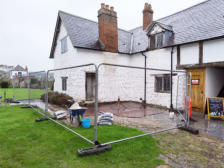
The Cae Ddôl lavatories could also
provide a seasonal kiosk
................................................................……………………………………….……………………..............
4
4
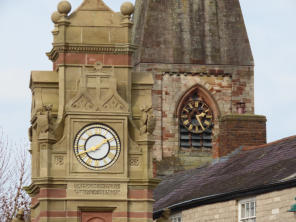
Timely news comes from the Town
Council and St Peter’s Church regarding
the church spire clocks.
For the better part of 2025, three of
the four clock faces have been out of
synch. Only one currently shows the
correct time (the least visible of the four).
Now, though, the Town Council has
agreed to help with the annual cost of
maintenance.
As a commemoration to those who
died in service during the Second World
War, St Peter’s Church and the town
through subscription raised funding to
install a new church spire clock and four
clock faces. It opened in 1948.
Recognised, therefore, as a war
memorial, the Town Council for some
years contributed towards the clock’s
maintenance.
However, all maintenance no matter
how funded, appears to have
ceased in 2019 at the installation
of the new church bells. For a
period, three of the four faces had
subsequently displayed an
incorrect time.
Given its status as a war
memorial, there was some doubt
locally about the ownership of the
clock. In 2026, it was established
on the balance of probability that
it was owned not by the town but
logically by the church.
Following constructive bilateral
discussions with the Warden of Ruthin,
the Town Council has again agreed to
assist towards the maintenance of the
spire clock following an agreement. The
church retains ownership, is responsible
for preventative and emergency
maintenance but in recognition of the
Clock Watch
Roundabout RIP 1962-2026
................................................................……………………………………….……………………..............
memorial the Town Council is pleased in
future to contribute a sum to cover the
annual or biennial service maintenance
(though not exceptional maintenance)
and would wish to assist the Diocese of
St Asaph towards the competition of any
grant funding applications for any future
renovations.
................................................................……………………………………….……………………..............
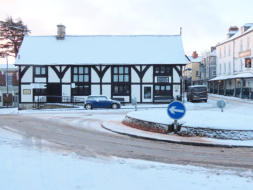
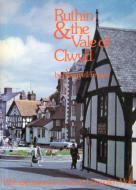
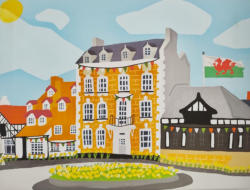
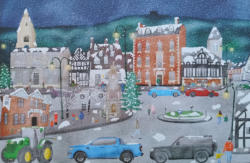
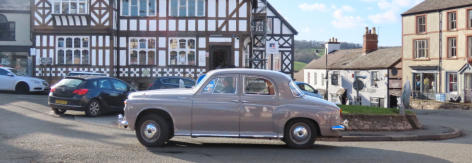
The Square’s roundabout has helped define Ruthin for nearly 65 years. Here are some views of it. Clockwise from top left: the
roundabout in February 2026; as depicted on a jigsaw produced for Cefi, Well Street; a St David Day’s depiction, with daffodils; on the
cover of a 1973 book, showing flowers but also two people crossing the road (using natural desire lines); and in winter.
Last season at Nantclwyd y Dre was
particularly strong in terms of visitor
numbers.
For the late March 2026 opening, the
house has undertaken significant
changes to its entrance, aiming to create
a more family-friendly environment that
invites exploration rather than
resembling a traditional museum. This
transformation seeks to foster a hands-
on engagement for visitors, an approach
that will be warmly received by families
who may have been put off by the more
traditional ‘feel’.
The back parlour has been
reimagined into the Dyer Gough area,
which now includes a smaller kitchen
reminiscent of those from World War II.
This reconfiguration aims to provide an
authentic glimpse at the past, enhancing
the educational aspect of the visit.
As renovations continue, the rear of
the house is expected to be completed
by mid-May, although progress has been
hindered owing to weather conditions
affecting the required lime wash
application. While it is possible to force
dry the lime wash, this method lacks
speed and requires careful application.
Looking ahead, Nantclwyd y Dre will
celebrate the 20th anniversary of its
opening in 2027, but the focus remains
on the forthcoming year, which is set to
strengthen its connection with the
nearby attractions.
The venue is also making efforts to
cater to last-minute wedding bookings,
providing unique experiences for
couples. Furthermore, under the
National Garden Scheme, the estate
again hosted February snowdrop walks.
that attracted 32 participants.
Fruit trees planted last year in the
Lord’s Garden are expected to flourish,
promising a vibrant spectacle for visitors.
Housing Project
5
Arts and Crafts
Movement in Ruthin by
Liz Williams
Towards the end of the 19th century and
the early part of the 20th, the Arts and
Crafts movement developed in the UK. It
was primarily evident in London and the
South of England and, later, filtered into
Wales and , in particular, to Ruthin.
We are fortunate in Ruthin to have
outstanding work from that period in
Nantclwyd y Dre, where Samuel Dyer-
Gough and his carpenter employees
(who had come to work for him) did
extensive alterations and restorations.
His first mammoth task was
uncovering the mostly oak beams, which
had all been covered with lath and
plaster and then whitewashed. It was
while doing that work he found a priests’
hole beneath the floorboards, complete
with a letter from the then Pope thanking
the residents of Nantclwyd y Dre for
giving safety to a priest.
The trend in the Arts and Crafts
movement was to value traditional,
handcrafted artistry over industrial
production.
While North Wales was not a major
hub for this movement, our area saw
various highly-skilled craftsmen making
remarkable woodcarving, mainly for
churches and chapels, and several rood
screens were created and restoration
work to existing rood screens was
undertaken.
Vibrant increase in printing ability
took place during this movement and
new printing machinery was developed.
At this time, Welsh churches saw the
influence of the Gothic Revival Style,
which would involve a lot of detailed
woodcarving and geometric tracery in
the Arts and Crafts tradition.
The philosophy behind the Arts and
Crafts movement lives on in
contemporary styles at Ruthin Craft
Centre.
William Morris (1834-1896) was the
most famous artisan craftsman of his
time. His was the famous quote, ‘Have
nothing in your house that you do not
know to be useful or believe to be
beautiful’.
These words of his reflect his
advocacy for craftsmanship and quality
over massed-produced, poorly-made
products.
Many William Morris-inspired
handmade designs were derived from
nature and and designed stained glass,
textiles, wallpaper and tiles. He wrote
about about his ideas: he was a
profound social reformer. He aimed to
improve working conditions and end
industrial exploitation and founded the
Socialist League aiming for communal,
equitable and beautiful living conditions.
Many of William Morris’s inspired
handmade designs are a lasting legacy
and his patterns are still relevant and are
still considered exquisitely beautiful
The County House look that modern
interior designers use is often the result
of William Morris’s creative genius. He
believed that art should not be a luxury
for the few but a vital part of daily life for
everyone.
5
A Certain Style
Heather Williams looks
at a positive story about
one of the things that is
happening in our lovely
community of Ruthin
In January, I heard about the possibility
that the Ruthin Repair Café had been
selected by BBC Breakfast TV to be
filmed and broadcast on nationwide TV.
Sure enough, at the February Repair
Café on February 7th, 2026 the cameras
were there to film for a feature that was
shown on BBC Breakfast on Tuesday
17th February. When I recently spoke to
my sister-in-law in the far north of
Scotland, she mentioned she’d seen this
item and was very impressed with what
was happening here.
The idea behind repair cafés is to
help the planet, save money and create
connections through skill sharing. The
Ruthin Repair Café first started in 2020
and has really taken off since then. The
repair cafés normally take place on the
first Saturday morning of the month in
the Naylor Leyland Centre in Well
Street (10am to 1.00pm - last orders
12.30pm). In April 2025, the group
celebrated fixing the 1,000th item and
the number which has now been
processed is over 1,600 items, with a
fix rate of 73 per cent. It is now one of
the busiest repair cafés of the 143 in
Wales, and in February 2026 it was the
52nd café session to be held.
The café is run completely by
volunteers, who freely give up their time
to repair and fix items which include
electrical and mechanical items,
jewellery, textile repairs, musical
instrument adjustments and software
support. There is a strong team of other
volunteers who greet people to identify
what item they wish the volunteer fixers
to look at, and also serve them with
drinks and delicious home-made cakes
while they wait. Altogether the team of
volunteers can be around 20 people!
While there is no charge for the
repairs, donations are welcomed, which
can sometimes be generous, reflecting
the value ‘customers’ place on the work
that the volunteers do. There is now a
limit of two items per customer, which
makes it fair to everyone coming.
Over the years I have taken items
which include an iron flex repair, a
jacket zip repair, and a ring adjustment.
What struck me was what a lively hub
of activity it was, with customers
chatting to each other and the
volunteers very friendly and engaged
making everything run in a smooth and
very efficient manner. If you think you
might have something, come along to
repair café.
Successful Repairs for the Ruthin Community Recognised on TV
……………………………………………………………………………………………………………………….
Join Ruthin & District Civic Association and help support our work and the
production & distribution of Town & Around
Annual subscription rates are £10 (individual) or £15 (joint/family). Please delete as appropriate
The Association tries to help protect & enhance the outstanding market town of Ruthin and the areas nearby. Our main aims are
to promote ‘civic pride’ in the town and surrounding villages. We also aim to promote high standards in planning and encourage
architectural excellence. We organise the annual Open Doors heritage weekends and the Quayle Awards.
Name (s) _______________________________________________________________________________________________
Address ________________________________________________________________________________________________
Telephone: __________________________ Email: ______________________________________________________________
Cheques payable to ‘Ruthin & District Civic Association. To pay by bank transfer or standing order, request that the Hon. Treasurer
contacts you with details of how to do so. Robert Williams, Hon. Treasurer, Lenton House, Mold Road, Ruthin LL15 1SL (tel.
704998 / ruthincivic@btinternet.com)

6
6
Heather Williams takes
a rare tour around the
remains of a building
that eventually
controlled our
education, our
highways and our
social services here in
Ruthin (and well
beyond)
My husband and I took the opportunity
recently to have a tour around the site
which became the headquarters of
Flintshire County Council and the former
Clwyd County Council. The tour was
conducted by Kevin Matthias, former
archivist at Clwyd County Council (and
later Denbighshire County Council) and
Paul Harrison, who has an architectural
practice in Mold.
We started our visit at Llwynegrin
Hall. In 1830, the hall was built as a
dowager house for the widowed step-
mother of Philip Davies-Cooke
(associated with nearby Gwysaney
estate). It was built in a Tudor style and
at that time was situated in a pleasant
countryside estate. The architect was
Thomas Jones, County Surveyor for
Flintshire County Council, who also
designed the old Flintshire County Hall
which can still be seen in Chester Street
in Mold behind the taxi rank.
The family moved out of the property
and it was then bought by Henry Cecil
Raikes, an MP who became the Deputy
■ 1967: Shire Hall Phase 1 built for
former Flintshire County Council.
1972-1974: additional phases added
to rear in anticipation of Clwyd County
Council
■ 1974: headquarters of Clwyd
County Council, where important
decisions about highways,
education and social services (and
much else) were made, affecting
Ruthin and district. Denbighshire’s
functions migrate to Shire Hall.
Relegation of Ruthin’s County Hall
to offices of a district council
■ 1996: reorganisation sees new
Flintshire rename the building as
County Hall. No longer providing
services for Ruthin but 44 education
and 15 other staff who transferred to
Denbighshire continued to be billeted
there because there was no offices for
them in Denbighshire.
■ 1998: last Denbighshire staff
move out, to Denbigh and Ruthin
■ 2020: demolition of Phases three
and four
■ 2025: building closed and awaiting
demolition
A brutal tale about the cost of
Speaker of the House of Commons. The
Raikeses moved out in 1886 and the
house went into ruins.
In 1908 Hugh Davies-Cooke took
over the house again, demolished some
of the ruins and extended it with two
wings. By 1937, the family had left and
the property was divided into two.
Flintshire County Council then
purchased the Hall and the surrounding
land in 1948 for £14,000. It was used for
various purposes by the council and was
designated a Grade II Listed Building in
1987. Presently it is now used as the
registry office for Flintshire, where
weddings can take place.
In 1954, the council started to
consider the need to have new offices in
the Llwynegwin Hall area. The first
building on the site was the seven-
storey block at the front of the site facing
Raikes Lane, which opened 1967, and a
three storey block with an enclosed
landscaped courtyard behind it.
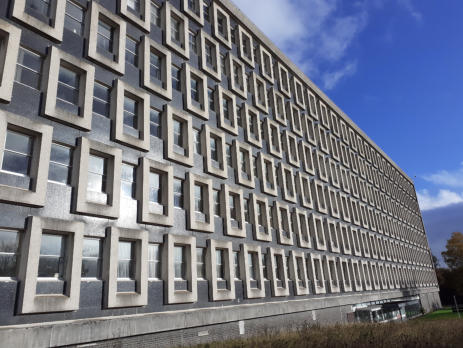
Robert Harvey, the Flintshire County
Architect was responsible for the design,
which was built in a distinctly modern
style known as ‘Brutalism’. It was
extended in 1972 and with local
government reorganisation in 1974
(when it became the headquarters of
Clwyd County Council), a further
extension with a glazed link bridge was
built to additional phases to the rear.
Brutalist architecture emerged in the
mid-20thCentury as a style
characterised by its use of raw concrete,
(the French word ‘béton brut’ means raw
concrete) with a focus on functionality
over decorative elements.
The distinctive techniques used for
the what till 1996 was Shire Hall were
very cutting-edge, with slabs of pre-cast

7
Brutalism
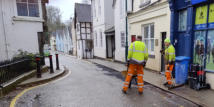
In preparation for the public realm
works ahead of us, the Highways
department has resurfaced Wynnstay
Road and treated the potholes on
Castle Street, above. Castle Street will
eventually be resurfaced.
And, in February, the contractors
undertaking the levelling up works set
up a compound in half of Park Road
car park, amusingly using a JCB to
remove what was an abandoned
vehicle.
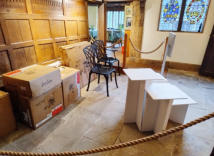
We mention of page 4 changes to the
entrance and foyer at Nantclwyd y Dre.
For those acquainted with that part of
the house, this work in progress will
seem very unfamiliar.
This
winter,
Open-
reach
and its
contr-
actor
have
been working on full
upgrades throughout
parts of the town. For
the first time for many,
this will give residents
access to full fibre at speeds previously
only available in The Old Courthouse (1
Gbps) and relatively cheap prices (£32
pcm is mentioned). Though the trunk
cable comes from the telephone
exchange on Park Road, the feed is
actually off the information super-
highway running on the A5 at Corwen.
Seen in Passing…

concrete blocks jacked up into position.
The windows were small with precast
concrete surrounds on alternate
windows, perhaps to give it a more
classical attractive appearance, and
black tiling which gave it a distinctive
look. This gave rise to some people
considering that it looked like Legoland!
After another local government
reorganisation in 1996, it became the
headquarters of the new Flintshire
County Council again. In a clear break
from the past, Flintshire renamed it
‘County Hall’. However, by 2020,
Flintshire decided it could not afford to
keep the offices open that was said to
cost £1.2m a year to run. Later that
year, the newer parts of the complex
started to be demolished. At the end of
February 2025, the Council stopped
delivering services from the remaining
buildings, which were due for
demolition. However, a year on, they are
still standing. Maybe it’s because
demolishing the buildings will cost a
significant amount of money!
So what went wrong? The innovative
techniques were not always tried and
tested. Mechanical ventilation and
heating techniques on buildings like this
were in their infancy. Over the years,
there were lots of problems with thermal
expansion, the joint seals, spalling, and
concrete cancer. Some windows were
not safe to open, stuck or difficult to
access. The work involved to address
all these issues was significant.
Contrast this with what has
happened to another building. The style
of the County Hall is very similar to the
American Embassy in Grosvenor
Square in Mayfair, London, that opened
in 1960 and was designed by Finnish
American modernist Eero Saarenin.
Unlike the offices in Mold, it has Grade
II listed building status and has recently
undergone an extensive 10-year-long
architectural restoration by Sir David
Chippendale. This has been at a cost of
close to £1bn. It reopened in September
2025 as the 5* Chancery Rosewood
Hotel, owned by Qatari Diar Europe
LLP, with 144 suites which start at
£1,400 a night.
So this is a tale of what a difference
that ownership, money and location can
make to the fate of two Brutalist
buildings.



8
8
Ruthin Future
From p1
iterative nature allows for adaptations
based on ongoing dialogue with
residents and stakeholders. This
flexibility has resulted in successive
updates to the plan, each reflecting
community feedback and priorities.
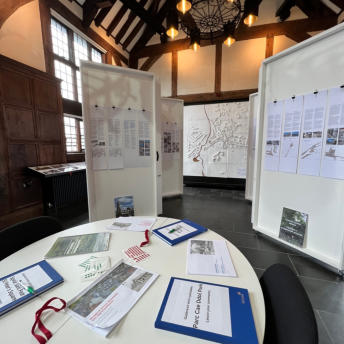
A cornerstone of the initiative is its
emphasis on community engagement
through ‘Urban Rooms’. These
temporary public spaces enable
residents to view proposals, share ideas
and participate in discussions related to
the town’s future. Urban Rooms have
been established at various venues,
including Ruthin Craft Centre and The
Old Courthouse, promoting accessible
dialogue. These pop-up events have
occurred periodically to engage
community members, providing
essential input that shapes the ongoing
evolution of the plan.
Ruthin Future’s framework revolves
around people, place, and potential,
prioritising themes such as heritage
conservation, public spaces, economic
sustainability, and connectivity. The
initiative informs vital public realm
projects aimed at enhancing St Peter’s
Square and improving footpath, cycle
links, and public spaces. These
upgrades will lead to a more vibrant
town center, supporting events, café
culture, and overall well-being. The
initiative acknowledges Ruthin’s rich
historic environment and seeks
harmonisation between regeneration
and heritage preservation. Engaging
with buildings like The Old Courthouse,
the initiative focuses on creating
community hubs within historic spaces.
Ongoing community engagement is vital,
using public exhibitions, surveys, and
events to invite resident to contribute.
These inputs are then analysed and
incorporated into evolving plans, with key
partnerships involving local businesses,
heritage bodies, and community
organisations. Ruthin Town Council
collaborates with Denbighshire County
Council, government programmes, and
community groups to secure funding for
alignment with the Ruthin Future vision.
This collective effort underpins concrete
projects that contribute to the initiative’s
goals.
Ruthin Future exemplifies long-term,
community-centered placemaking that
balances heritage and sustainability. By
embedding engagement at its core and
fostering diverse projects, the initiative
showcases how co-ordinated actions can
transform a more resilient town centre.
Ruthin Future 2026: 10 Days of
Placemaking, Heritage & Community
Engagement
The March 2026 programme represents
a focused effort to engage the public
through exhibitions, workshops, talks,
civic events, and themed forums,
providing multiple ‘entry points’ for
community input. The opening evening
on Thursday, March 19th features a
Townscape Talk by Dr Elaine Davey
discussing the importance of heritage.
On Friday 20th, the exhibition opens at
The Old Courthouse, accessible daily,
showcasing proposals and themes
prioritising community feedback.
On Saturday 21st, the Ruthin Mini Photo
Marathon encourages residents to
document the environment through a
placemaking lens. The Ruthin Town
Council Civic Awards on Monday 23rd
recognises local contributions to the
community. On Tuesday, 24th, there will
be an Events Forum aimed at
strengthening the annual events
calendar. Then on
Thursday 26th, a
discussion on Parc
Clwyd explores green
infrastructure and
community well-being.
The 10-day
programme is
structured around five
engagement strands,
making it easy for
residents to
participate in
discussions and
activities. This
engagement period
offers an excellent
opportunity for
residents to influence
various aspects of
Ruthin’s future,
ensuring that their
voices help shape
policy, public spaces,
and community life.


Town & Around is published
quarterly by the Ruthin & District Civic
Association. It is available from Ruthin
Library and on townandaround.org.uk.
It is delivered free to Civic Association
members
Editor, Layout & Design:
Peter Daniels cymru@clwyd.org
Secretary: Heather Williams
ruthincivic@btinternet.com
We welcome articles, contributions,
suggestions and letters in Welsh or
English
Please send them to the Editor at
cymru@clwyd.org or
Coedlan, 25 Stryd y Brython,
Ruthin, LL15 1JA
The deadline for the next edition is
May 16th, 2025
Thanks are due to this quarter’s
contributors: Peter Daniels,
Anne Roberts, Heather Williams and
Liz Williams
Views expressed by contributors
are their own and neither
necessarily reflect those of the
Civic Association nor those of their
employers
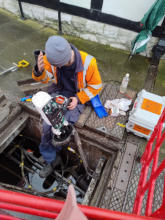
© March 2026
Ruthin &
District Civic Association