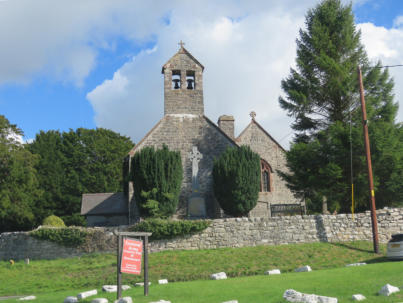
Llanelidan
In March 2007, Hafina Clwyd celebrated the village of Llanelidan. To her list
of closures, in 2018 we must now add the parish church…
Those of us hijacked by genealogy often believe
that there is a conspiracy to stop us finding
certain details of our family history. I certainly
did when I discovered that the 1841 and 1861
census returns for Llanelidan parish are
missing. Most unfortunate and frustrating!
Nevertheless, I have managed to trace my
paternal family tree back to the 1660s in this
village. My ancestors lived on farms at Gwrych
Bedw, Bodlywydd Fawr, Tyddyn Uchaf and Pwill
Naid. So this parish has a special place in my
heart.
Llanelidan is divided into five
townships—Nantclwyd, Llan, Bryncyme,
Bodlywydd and Garthneuadd. The parish
church, which is mentioned in the Norwich
Taxation of 1254, is dedicated to Elidan (she
seems to have had local connections, but we
don't know when she lived). It merits a visit as it
has some fine wood carving, mediæval glass,
and, like several other churches in the Vale of
Clwyd, a double nave. The village has seen many
changes over the centuries, but it still has a
rather feudal air.
The first three entries in the parish register are
of the baptism of Maria, daughter of Eubule and
Susan Thelwall, 26 September 1686; the funeral
of Ephraim Thelwall, 8th February 1695; and the
marriage of John Gryffith & Gwen Robert in
1697. In the churchyard, under a large yew tree,
is the grave of John Jones, a petty thief known as
Coch Bach y Bala; close by lies the Revd John
Morris, who conducted Coch Bach's funeral in
1913, after he (Jones) had been shot in
Nantclwyd Woods by Reginald Jones-Bateman of
Eyarth—much to local consternation.
Across the road from the church is the Leyland
Arms, which for many years was run by the
Evans family, all of whom were teetotal! One of
the daughters, Florence Anne, married Thomas
Ellis Price of Pen y Rhiw, a schoolmaster at
Pentrecelyn. In 1912 they emigrated to lowa,
where Thomas had a large shop and formed a
male voice choir. They were married for 70
years; Florence died on her 99th birthday in
1986.
Over centuries, farms have disappeared and
fine houses raised to the ground. The school,
shop and two chapels have closed and most of
the original families have moved away. [The
parish church looks set to follow, open in the
future on selected days only as a “pilgrim
church”—Ed]. The devastation and depopulation
is well illustrated in an essay by Richard Wynne
of Rhewl Felyn, which won him a prize at the
Bryn Banadl chapel eisteddfod in 1920. He
mentions the local herbalist Susannah Ellis, Pant
Rhedynog, who made an ointment using mould
she cultivated from the top of jam. Alexander
Fleming did something similar in the 1930s and
called it penicillin. A mediæval Susannah would
have been burnt at the stake; in the 20th
century she would have gone to medical
school.
Gomer Roberts, Cefn Griolen, chapel deacon,
alderman, and JP in the early 20 century, wrote
Atgofion Amaethwr (Memoirs of a Farmer),
published by the Merioneth History Society; it
is an invaluable portrait of late 19th century
life.
Llanelidan today is a tranquil spot, well known in
horticultural circles for Dibley’s Nurseries, Cefn
Rhydd, winner of many prizes at the Chelsea
Flower Show, and special home of the
streptocarcus [not something that requires
treatment by Susannah Ellis!—Ed].

Town and Around Current Edition
Town and Around Historic Contents
Contact Us
Ruthin Local Historic Society
Copyright © 2018 Ruthin & District Civic Association