The White Horse becomes
the Myddelton
Writing in June 2012, Gareth Evans offers a different view of “The Myd”
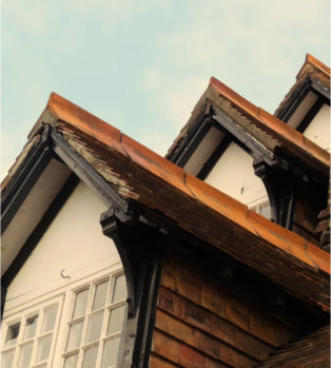
The Myddelton on the Square with its distinctive
layers of dormer windows has caught many a
visitor’s eye. Sir Hugh Myddelton is supposed to
have given the building its name and Sir Richard
Clough, the distinctive Dutch style roof.
The first buildings would have had mud walls
and a thatched roof with few rooms or perhaps
only one. The building, like all others around it,
would have served the needs of the market. It
was a good site looking out over Market Place
where frequent markets and regular fairs were
held.
From the fifteenth century, a great rebuilding
occurred in Ruthin, as confidence returned after
the Glyndŵr revolt. The black and white half
timber buildings, so characteristic of Ruthin,
began to be constructed and The Myddelton
building dates from that period. CADW date it to
the end of the sixteenth century with much
seventeenth century remodelling.
The owners of the plot can be traced back
nearly to Glyndŵr’s time. The owners, all
families who were part of the ruling elite,
probably treated it as a speculative
development to rent, choosing to live in a
quieter location away from the hubbub and dirt
of the market. It was owned in succession by the
Sergeants, Calffs and Moyles and one of these
families built it. The distinctive roof was
probably a later addition, and there is no sign of
it in a 1714 print of the Square.
Sometime in the 17th century, the property was
acquired by the Langfords, who already owned
properties nearby, next to the church. They may
never have lived there but undertook building
works and left their coat of arms in plasterwork
which still survives in the building. They still
owned the property in the eighteenth century,
although no longer living in Ruthin.
A scattering of references to their tenants
survive. By 1670 Robert Williams is recorded
living there. The building was at this time more
substantial than the White Lion next door,
having four fireplaces compared to the latter’s
two. Peter Edwards, possibly a mercer, rented it
at the end of the 17th and early 18th centuries.
By 1692, it was an alehouse and it continued as
such throughout the 18th century.
The property was sold to Richard Myddelton in
1772, and the property document was endorsed
on the outside with The White Horse. After the
purchase, Mr John Jones, landlord of the White
Lion, later the Castle Hotel, took over the White
Horse building as well.
However it seems that the former licensee of
the White Horse and his clientèle did not take
kindly to this take-over. Soon there was a White
Horse functioning again next door, where
today’s Bar Llaeth is and by 1809 there were
two, the Old White Horse and New White Horse,
the former presumably reopened by the
Myddeltons to reclaim customers. In 1815, there
were three White Horses suggesting some
continuing grievances and the licensing justices
intervened to rationalise the names. The Old
White Horse had become the Castle Arms bar
by 1844 and this merged with the Castle Hotel in
the 1870s.
In Victorian times, in the 1860s and 1870s, the
White Horse building was split into a
confectioner's shop and the Castle Arms. By
1891the building again contains two businesses,
a temperance hotel and Charles Phillips running
the Myddelton Arms Hotel. By 1901, the
temperance hotel has become Henry Joyce, the
watchmaker’s shop and he was still there in
1919 when his shop was sold separately.
In 1999 the Myddelton Arms was marketed
separately and by 2003 was owned by Punch
Taverns. It continued to trade separately until
recently and is now reopened after a period
being closed and for sale. The name has no long
historic connection but seems to have been
adopted as a transitory convenience; the only
historic connection with any resonance seems
to be the White Horse.

Town and Around Current Edition
Town and Around Historic Contents
Contact Us
Ruthin Local Historic Society
Copyright © 2018 Ruthin & District Civic Association


