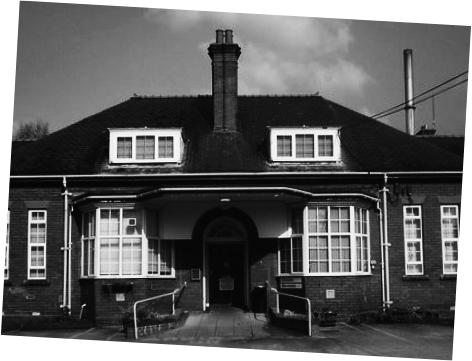
Ruthin Community Hospital
One question which immediately comes to
mind is how did our cherished and much
loved hospital come to be built in the first
place, and how was it run when, unlike in
this more ailment age, we were all much
poorer?
For the answer we have to go back to the
Poor Law Amendment Act of 1834, which
required the Poorlaw Commissioners to
build Workhouses and look after the poor.
It was not until three years later, on 2nd
March 1837, that the Ruthin Board of
Guardians, made up of the local worthies,
met to consider the matter. The question
which soon arose was, where would the
Workhouse be built and how large would
Ruthin’s be?
One has to remember the lack of water and
sewerage facilities of those days, and that
upwards of 100 residents would be involved,
with space for some 25 vagrants. There were
factors which had to be considered before any
building work could commence. Local
landowners ranging from Sir Watkin Williams
Wynn to Harriet Myddelton and Sir Robert
Vaughan, with sites such as Galchog Dingle and
other sites north of Llanfwrog, near a timber
yard at the foot of Prior Street, and in Well
Street, were all approached to sell, and all
refused. There was also a very strong
movement for land near the Telpyn Bridge in
Rhewl to be purchased.
After years of wrangling and pressure from local
residents on the Board, the croft belonging to
the Anchor Inn in Rhos Street was finally
purchased for the sum of even. By 1837 the
Workhouse was completed. Soon after 1910,
the Board of Guardians decided that facilities
needed to be improved by the provision of
improved medical facilities. The project went
ahead and the hospital opened in 1915. It
consisted of two wards of 16 beds for males and
females, two private wards, a maternity theatre,
an operating theatre and an x-ray department.
The x-ray unit had been generously gifted by Sir
Henry Tate (of Tate and Lyle) who leased Pool
Park until 1934 when it was taken over by the
District Health Board.
As it was wartime and space was available, its
facilities were made available by the Board of
Guardians to the VAD (Voluntary Aid
Detachment) of the Red Cross as a convalescent
home for injured servicemen.
The first matron or Commandant was Mrs Violet
Springman of Bryn Mair, Llanfair D C. She was
the wife of a Liverpool cotton broker, H H
Springman, an international Rugby player. I
have a precious postcard dated 16th December
1916 of the hospital, from Mrs Springman and
addressed to a friend in Rhyl. The card clearly
shows the size of the original building and a
glimpse of the soldier patients and staff.
After the World War, with the blessing of the
then Welsh Board of HeaIth, it became a general
hospital. A surgeon who had moved into the
area in 1918, Hugh Morriston Coote Davies, to
be Superintendent of the Vale of Clwyd
Sanatorium, Llanbedr Hall provided valuable
encouragement and assistance. Ruthin also had
a very well endowed private hospital at the
Castle under the direction of Sir Edmubd
Spriggs. He and his staff, Mr Patterson,
Anderson and surgeons from Liverpool, Chester
and Wrexham were on hand with practical
advice.
When the National Health Service was set up n
1948 to provide a free medical service to all,
Ruthin Hospital became a General Practitioner
Hospital. The Denbighshire Archives had not
been set up. During the changeover to the NHS
and due to the lack of storage space most of the
records held at the hospital were destroyed.
Over time additional building was carried out to
extend the hospital by the addition of new and
more modern facilities. It is now a very much
appreciated Community Hospital with virtually a
full range of both inpatient and outpatient
services ranging from the minor injuries and the
x-ray department to physio and occupational
therapy, foot clinics, a centre for district nurses
and a much valued day centre. It would be tragic
to lose them.
GWYNNE MORRIS considered its future in December 2012 and looked back to its
past

Town and Around Current Edition
Town and Around Historic Contents
Contact Us
Ruthin Local Historic Society
Copyright © 2018 Ruthin & District Civic Association


